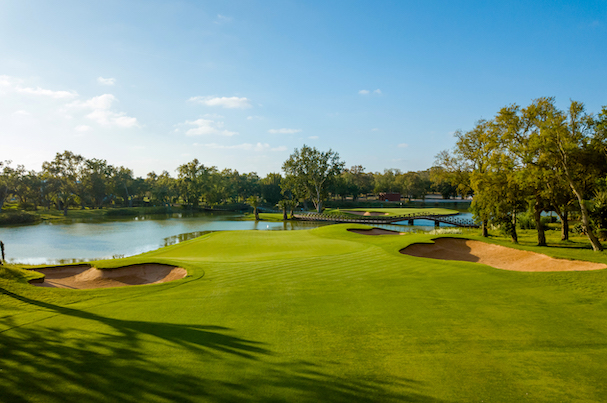
Dar Es Salam Red
Robert Trent Jones Sr carved the Red Course at Royal Golf Dar Es Salam through a dense cork oak forest south of Rabat in 1971, and it remains one of the finest and most demanding things he ever built. A par 73 of about 7,300 yards, the longtime home of the Trophee Hassan II, it is a giant of a parkland framed by ancient trees and a famous island green.
Photo: World Amateur Tour via Google.
The verdict
Dar Es Salam was commissioned by King Hassan II, who gave Robert Trent Jones Sr a 440 hectare cork oak forest near Rabat and a free hand, and the Red Course that opened in 1971 is widely regarded as one of the best courses Jones ever designed. The corridors are cut tight between mature cork oaks, the par 73 routing is long and uncompromising, and the conditioning has long set the Moroccan standard.
It is a course of scale and shade, the trees pressing in on every drive, the greens large and well defended. The most famous hole is the par 3 played across a lake to an island green, the signature of the Hassan II Trophy that has been contested here every year since the course opened. A recent renovation refreshed the greens and bunkering, and the Red remains the centrepiece of golf in Morocco.
Royal Golf Dar Es Salam, Red Course at a glance
- Opened
- 1971
- Designer
- Robert Trent Jones Sr, 1971
- Type
- Cork oak forest parkland
- Par
- 73
- Yardage
- About 7,300 yds
- Green fee
- Resort
Designer, opening year, par and yardage verified June 2026 from the club and leading course databases. The Red Course at Royal Golf Dar Es Salam was designed by Robert Trent Jones Sr and opened in 1971, commissioned by King Hassan II on a cork oak forest estate south of Rabat. A par 73 of about 7,300 yards with a famous island green par 3, it is widely rated one of Jones's finest and is the longtime home of the Trophee Hassan II. Indicative fees change by season and year, so always confirm access and any green fee directly before booking.
The holes worth the trip
The Red Course is all about driving accuracy. Robert Trent Jones Sr lined the fairways with cork oaks so mature and so close that the tee shot is the whole battle; miss the corridor and the trees, not the rough, take your medal. At par 73 and well over 7,000 yards it is a long day, and it favours the player who can shape the ball both ways.
The greens are large, classic Trent Jones targets, and the bunkering frames them on the diagonal so the approach must be flighted to the right portion. The famous par 3 across the water to an island green is the photograph everyone takes, but the strength of the Red is the relentless quality of the long par 4s through the forest.
It closes as a championship test should, the trees and the length never relenting, the greens demanding precise pace. The Red rewards control and patience over power alone, and it gives back the rare experience of tournament parkland golf played in the cool shade of a Moroccan cork oak forest.
How to get on
| What to know | Detail |
|---|---|
| Access | Open to visitors as part of the royal golf complex; book a tee time in advance, particularly around the Hassan II Trophy |
| Green fee | Resort and visitor green fee quoted by the club and varying by season; treat published rates as indicative (indicative, 2026) |
| Booking | Reserve through the club or a Morocco golf specialist; the Red is the premium of the three courses on site |
| On the day | Caddies are customary and recommended on the long forest layout; carts available |
| Getting there | About 15 to 20 minutes south of central Rabat, and roughly an hour from Casablanca's Mohammed V airport |
| Best months | October to May for the mild Atlantic coast season, avoiding the height of summer heat |
Access arrangements verified June 2026; policies change, so always confirm directly before planning a visit with the club or your trip planner.
Where to stay nearby
Most visiting golfers base in Rabat, the Atlantic coast capital, which offers a strong choice of hotels within easy reach of the course and the wider sights of the medina, the kasbah and the royal city. A Rabat base puts all three Dar Es Salam courses on the doorstep.
Dar Es Salam pairs naturally with the courses around Marrakech and Agadir for a wider Moroccan golf tour, the forest parkland of the capital against the desert and oceanfront designs further south. It is an easy country to string together for a week of varied, good value golf.
Looking for a base? See our recommended hotels and resorts near Royal Golf Dar Es Salam, Red Course.
Build a Rabat golf trip
We secure the Royal Golf Dar Es Salam, Red Course tee times where access allows, pair them with the best of the region and book the lodging around them. Tell us roughly when and who is travelling and one concierge costs it to the head, with no obligation.
Royal Golf Dar Es Salam, Red Course questions
Who designed the Dar Es Salam Red Course and when did it open?
The Red Course at Royal Golf Dar Es Salam was designed by Robert Trent Jones Sr and opened in 1971, commissioned by King Hassan II on a cork oak forest estate south of Rabat.
What is the par and length of the Red Course?
The Red Course is a par 73 of about 7,300 yards, a long parkland championship test cut through mature cork oaks.
Can visitors play the Dar Es Salam Red Course?
Yes. The Red Course is open to visitors as part of the royal golf complex; tee times should be booked in advance, especially around the Trophee Hassan II.
What tournament is played at Dar Es Salam?
The Red Course has hosted the Trophee Hassan II every year since it opened in 1971; in recent seasons the event has been played on the PGA Tour Champions.
Related
The Tee Sheet
Tee time windows, course access changes and the trips worth taking. Every other week.
Researched and written by the GolfForKings editorial desk. Designer, opening year, par and yardage verified June 2026; indicative green fees verified June 2026. Last reviewed June 2026.