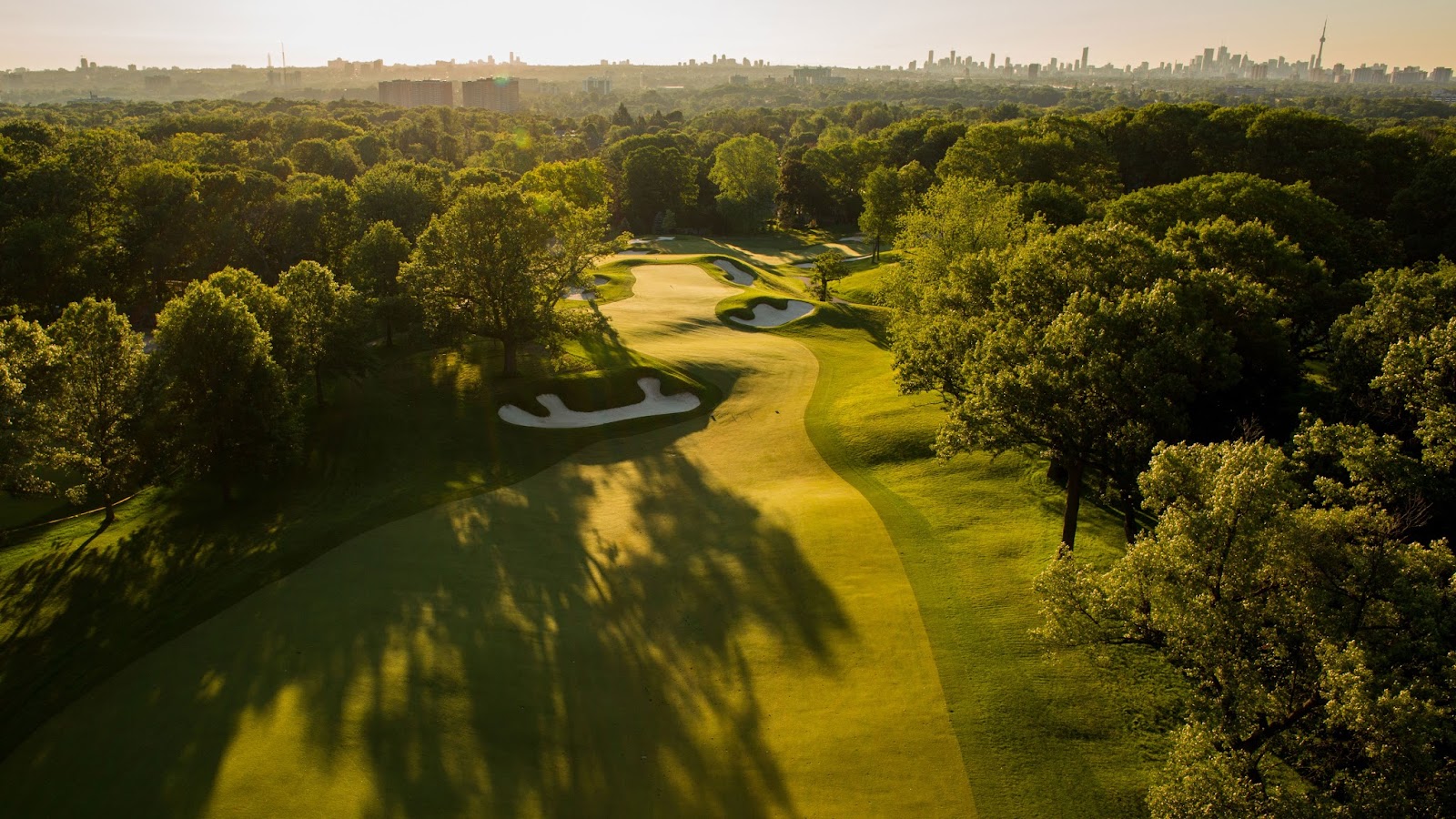
St George's Golf and Country Club
Stanley Thompson built St George's into the sandy, rolling ground of west Toronto in 1929, and it has spent the decades since trading places at the top of Canada's rankings. A par 71 of about 7,025 yards with deep bunkers and crowned greens, it has hosted the Canadian Open six times and is, for many, the finest course in the country.
Photo: St. George's Golf Club via Google.
The verdict
St George's is Stanley Thompson's Toronto masterpiece, and a strong claim for the best parkland course in Canada. Thompson, the most influential of all Canadian architects, was handed a stretch of glacial, sandy ground in Etobicoke in the late 1920s, and he used the natural ridges and hollows to route a course that feels both grand and entirely natural. It opened in 1929 and has been a fixture at the summit of the national rankings ever since.
The hallmark is the combination of bold, deep bunkering and small, crowned greens that shed anything but a precise approach. There is real elevation change, the kind that makes club selection a genuine puzzle, and a closing stretch that has decided Canadian Opens. When the tour returned in 2010 and again in 2022 the course held up beautifully against modern power. For a traveling golfer it is a bucket list round in the Canadian game, demanding, handsome and quietly intimidating.
St George's at a glance
- Opened
- 1929
- Designer
- Stanley Thompson
- Type
- Parkland (private)
- Par
- 71
- Yardage
- About 7,025 yds
- Access
- Members and guests
Designer, opening year, par and yardage verified June 2026 from the club and leading course databases. St George's is a par 71 of about 7,025 yards designed by Stanley Thompson and opened in 1929, a six time Canadian Open host. It is a private members club, so it does not publish public green fees; play is by member introduction or invitation. Always confirm access and any arrangements directly before traveling.
The holes worth the trip
St George's defends itself with bunkers and greens rather than water. Thompson's bunkering is deep and dramatic, set into the slopes so a tee shot that drifts toward trouble is genuinely penalized, and the fairways tumble over ridges that leave hanging and uphill lies for the unwary. The routing climbs and falls across the property so that few approaches are played from a flat stance.
The greens are the signature. They sit up on natural plateaus, crowned and firm, repelling anything that lands without the right spin and angle, and the surrounds are shaved so a marginal miss runs well away from the hole. Recovery is an art here, the short game tested as much as the long, and the par 3s in particular demand a committed, well flighted iron to hold the putting surface.
The finish is one of the toughest in Canadian golf, a sequence of long, uphill, heavily bunkered holes that has settled championships. Play St George's once and you understand why it has hosted six Canadian Opens and why Stanley Thompson's name still carries such weight north of the border.
How to get on
| What to know | Detail |
|---|---|
| Access | Private members club; play is generally by member introduction or invitation rather than public tee time |
| Green fee | No public green fee published; guest play is arranged through a member or a recognized reciprocal or event |
| Caddie and cart | Walking is the tradition; caddies and carts available by arrangement |
| Booking | Through a member host, a society or corporate event, or a golf trip planner who can advise on access |
| On the day | Smart traditional dress code; soft spikes; first class practice facilities, so arrive early |
| Getting there | Etobicoke in west Toronto, about 25 minutes from downtown and close to Toronto Pearson airport |
Access verified June 2026 from the club and public sources. As a private club St George's does not publish visitor green fees, and access is at the club's discretion, so always confirm arrangements directly before traveling.
Where to stay nearby
St George's sits in the leafy west end of Toronto, so the simplest base is a downtown Toronto hotel, twenty five minutes away, or one of the airport hotels near Pearson if you are flying in to play. The city gives you the dining, the waterfront and the culture for any non golfers, with the club an easy drive out.
For golf, St George's anchors a southern Ontario tour of championship parkland. Pair it with Harry Colt's Hamilton in nearby Ancaster and Jack Nicklaus's Glen Abbey in Oakville, all within an hour of each other, for three of the most storied venues in the Canadian game, then add Niagara wine country to round out the week.
Looking for a base? See our recommended hotels and resorts near St George's.
Build a Toronto golf trip
We help arrange access where we can, route the classic Toronto championship courses around St George's, and sort the city hotels and transfers. Tell us roughly when and who is traveling and one concierge costs it to the head, with no obligation.
St George's questions
Who designed St George's Golf and Country Club?
St George's was designed by the celebrated Canadian architect Stanley Thompson and opened in 1929, originally associated with the Royal York hotel. It sits in Etobicoke in the west end of Toronto.
What is the par and length of St George's?
St George's plays to par 71 and measures about 7,025 yards from the back tees, routed over rolling, sandy parkland ground with deep bunkering and crowned greens.
Has St George's hosted the Canadian Open?
Yes. St George's has hosted the Canadian Open six times, in 1933, 1949, 1960, 1968, 2010 and 2022, and is frequently ranked the number one course in Canada.
Can visitors play St George's?
St George's is a private members club, so play is generally by member introduction or invitation rather than public tee time. A golf trip planner can advise on access within a wider Toronto itinerary.
Related
The Tee Sheet
Tee time windows, course access changes and the trips worth taking. Every other week.
Researched and written by the GolfForKings editorial desk. Designer, opening year, par and yardage verified June 2026; access verified June 2026. Last reviewed June 2026.