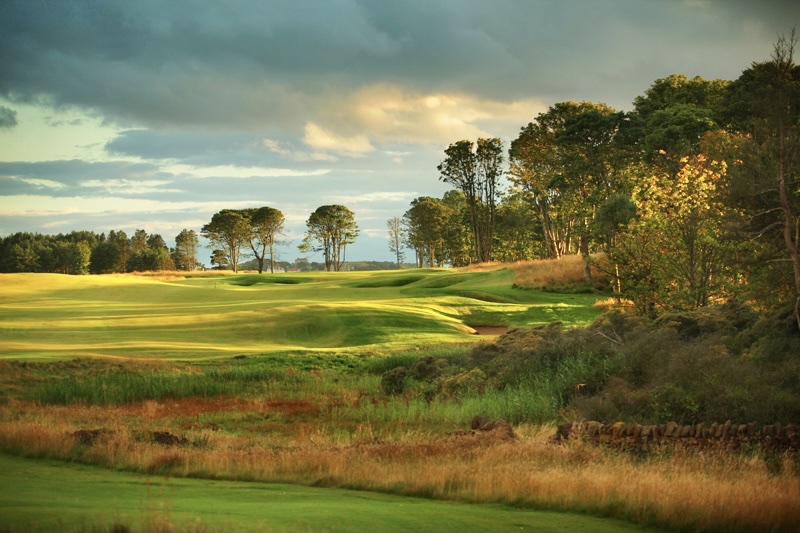
The Renaissance Club
The Renaissance Club is the modern entry on a coast of ancient links, a Tom Doak design that opened in 2008 and has hosted the Genesis Scottish Open every year since 2019. It sits on the Archerfield Estate between Muirfield and North Berwick, and its newest holes run right down to the Firth of Forth.
Photo: The Renaissance Club via Google, contributor World Amateur Tour.
The verdict
For years the Renaissance was the quiet, tree lined member of the East Lothian set, but the holes Doak built on land bought from the neighbouring Honourable Company changed that. The closing stretch now breaks out of the woods and onto the open coast, with the Firth of Forth, Craigleith and the Bass Rock filling the view, and it is here that the Scottish Open is so often won and lost the week before the Open.
This is a polished, strategic course rather than a rugged old links, and that is its appeal. The conditioning is immaculate, the routing gives you width to think and angles to attack, and tour players rate it highly as a final tune up on fast running turf. For the travelling golfer it is the hardest tee time of the East Lothian group to come by, but a memorable one if you can.
The Renaissance Club at a glance
- Founded
- 2008
- Designer
- Tom Doak
- Type
- Links
- Par
- 71
- Yardage
- 7,300 yds
- Green fee
- Members and guests
Designer, year and yardage verified June 2026. The Renaissance Club was designed by Tom Doak and opened in 2008, with a substantial revision in 2014 and new coastal holes added on land acquired from the Honourable Company of Edinburgh Golfers. It plays par 71 at around 7,300 yards, set up near par 70 for the Genesis Scottish Open, which it has hosted since 2019. As a private members club it has no published visitor green fee; access is by member introduction or selected trip packages, so always confirm directly before booking.
The holes worth the trip
The round begins inland among the pines of the Archerfield Estate, a sheltered, parkland feeling start that masks what is coming. Doak uses the trees and the contours to set angles, and the early holes reward the player who works out which side of the fairway opens up the green.
The character changes entirely on the back nine, where the newest holes spill out toward the Firth of Forth. The par 3 over a gully and the long par 4s along the coast, with the Bass Rock and Craigleith offshore, are the holes the Scottish Open is built around, exposed to the wind and demanding precise iron play into firm greens.
The finish gives the tournament its drama, a closing run where birdies and disasters are both on the table depending on the wind, which is exactly why the DP World Tour and PGA Tour return every July. It is a fitting warm up for the Open the following week.
How to get on
| What to know | Detail |
|---|---|
| Access | A private members club on the Archerfield Estate; play is by member introduction or through selected trip and stay packages, not general public booking |
| Green fee | No published visitor green fee; access and any guest rates are arranged privately, so confirm directly before planning a round |
| Booking | Arrange well ahead through a member or an approved trip planner; tee times are limited and the course closes around the Scottish Open in July |
| On the day | An immaculately conditioned course with caddies and buggies available and a fine modern clubhouse overlooking the links |
| Getting there | Near North Berwick in East Lothian, about 30 to 40 minutes east of Edinburgh by car |
| Best months | May to September for firm turf and long days, though access is most restricted around the Scottish Open week |
Access and indicative green fees verified June 2026; they change without notice, so always confirm directly before booking with the club or your trip planner. Check tee time availability.
Where to stay nearby
North Berwick is the natural base, a handsome seaside town with hotels and guest houses and its own famous West Links, and from here you are minutes from the Renaissance, Muirfield, Gullane and Archerfield for a full East Lothian week.
Edinburgh is close enough to combine city and coast, with the airport around 30 to 40 minutes away, so many groups split a stay between the capital and North Berwick.
Looking for a base? See our recommended hotels and resorts near The Renaissance Club.
Stay and play the Renaissance and East Lothian
Access to the Renaissance is limited, so we work with the right partners to secure a round where possible and build the week around Muirfield, North Berwick and Gullane. Tell us roughly when and who is travelling and one concierge costs it to the head, with no obligation.
The Renaissance Club questions
Who designed the Renaissance Club?
The Renaissance Club was designed by the American architect Tom Doak and opened in 2008. It was revised in 2014, and Doak later added new holes along the Firth of Forth on land bought from the neighbouring Honourable Company of Edinburgh Golfers.
What is the par and yardage of the Renaissance Club?
The course plays par 71 at around 7,300 yards from the back tees, and is set up close to par 70 for the Genesis Scottish Open. Its defence is the wind off the Forth and firm, fast greens.
Does the Renaissance Club host the Scottish Open?
Yes. The Renaissance Club has hosted the Genesis Scottish Open, co sanctioned by the DP World Tour and the PGA Tour, every year since 2019, the week before the Open Championship.
Can visitors play the Renaissance Club?
It is a private members club without a published visitor green fee. Play is generally by member introduction or through selected trip and stay packages, so arrange access well in advance.
Where is the Renaissance Club?
The Renaissance Club is on the Archerfield Estate near North Berwick in East Lothian, between Muirfield and the town, about 30 to 40 minutes east of Edinburgh.
Related
The Tee Sheet
Tee time windows, course access changes and the trips worth taking. Every other week.
Researched and written by the GolfForKings editorial desk. Founding year, designer, par and yardage verified June 2026; indicative green fees verified June 2026. Last reviewed June 2026.