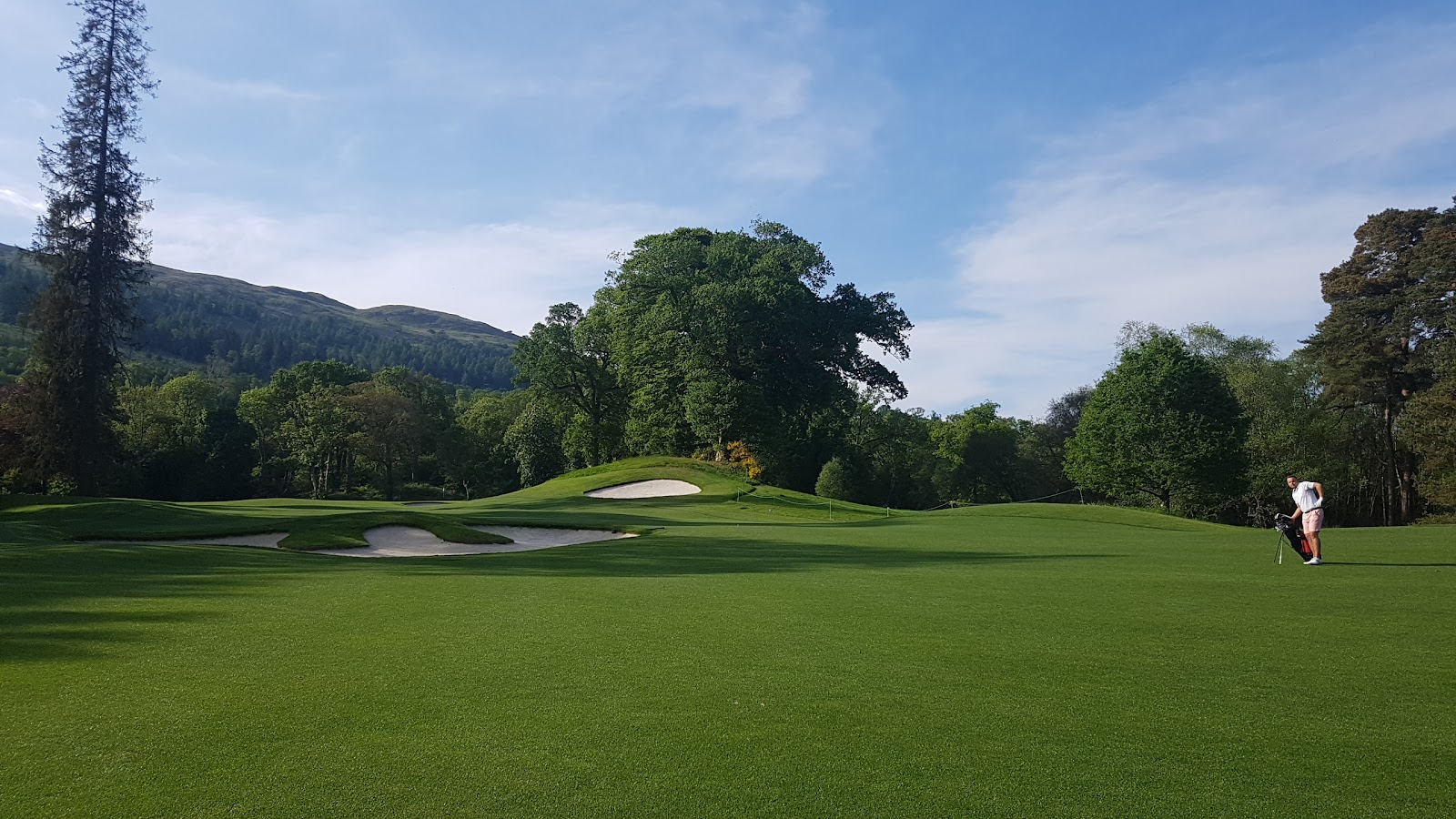
Loch Lomond Golf Club
On the wooded banks of Scotland's most famous loch, Loch Lomond is the country's great parkland course and one of the most exclusive clubs in golf. Designed by Tom Weiskopf and Jay Morrish and opened in 1993, it hosted the Scottish Open for fifteen years and is routed through ancient oak woodland to a finish beneath the ruins of Rossdhu Castle.
Photograph: Loch Lomond Golf Club, via Google
The verdict
Loch Lomond is the finest inland course in Scotland and, by most reckonings, the best parkland course in Great Britain. It is a deliberate counterpoint to the country's famous links: where Scotland's seaside courses are open, firm and wind blown, Loch Lomond is sheltered, soft and framed by ancient oaks, with the loch and the hills of the Trossachs as a backdrop on almost every hole. Tom Weiskopf, the 1973 Open champion, and Jay Morrish drew it through the woodland of the old Rossdhu estate and opened it in 1993, threading fairways between mature trees, along the shoreline and across pockets of wetland to produce something that feels both grand and intimate.
For the travelling golfer, Loch Lomond's appeal is its rarity and its quality. It hosted the European Tour's Scottish Open from 1996 to 2010, in the week before the Open Championship, and staged the 2000 Solheim Cup, so the best players in the world have tested it and rated it. It is also one of the most private clubs in the game, with an international membership and no public access, which only adds to its mystique. A round here is played as the guest of a member rather than bought, but for anyone building a west of Scotland golf trip it is the jewel to aim for, a soft and beautiful complement to the great links of Ayrshire just down the road.
Loch Lomond at a glance
- Opened
- 1993
- Designers
- Weiskopf & Morrish
- Type
- Parkland
- Par
- 71
- Yardage
- Around 7,100 yds
- Access
- Private, member guest
Designers, opening year, par and yardage verified June 2026 from the club and course databases. Loch Lomond is a par 71 of around 7,100 yards. It is a strictly private members club with no public green fee; access is as the guest of a member, and any cost is arranged privately. Policies change, so always confirm directly before planning a visit.
The holes worth the trip
Loch Lomond builds slowly and finishes hard by the water. The closing stretch is its calling card, beginning with the par 3 17th, which plays across an inlet of the loch to a green pressed against the shoreline, a beautiful and unnerving short hole where the water is in play the whole way and the wind funnels down the glen. From there the par 4 18th sweeps along the loch and turns back toward the clubhouse, finishing in the shadow of the ruined Rossdhu Castle and the Georgian mansion of Rossdhu House, as photogenic and dramatic a finish as parkland golf offers anywhere in Britain.
The body of the course rewards position and patience. The long par 5s give up birdies to the bold, but the tree lined corridors, subtle wetland carries and large, contoured greens ask for precise iron play rather than brute force. Weiskopf and Morrish used the natural drama of the estate sparingly and well, letting the loch, the oaks and the hills do the framing while the strategy stays in the angles and the green complexes. It is a course you can score on if you drive it straight and a course that quietly dismantles a wayward round, all in surroundings that rank among the most beautiful in golf.
None of it depends on the wind the way a links does. At around 7,100 yards, par 71, Loch Lomond defends itself with trees, water, soft turf and clever green sites rather than the gales of the coast, so it tends to play long when wet and rewards the player who flights the ball well and stays below the hole. It is a different test from the Scottish links, and a wonderful one.
How to get on
| What to know | Detail |
|---|---|
| Access | A strictly private members club; there is no public green fee or pay and play tee sheet, and play is as the accompanied guest of a member |
| Green fee | None published for visitors; any guest cost is arranged privately between member and host, so we quote no figure |
| Booking | Arranged by your member host; the club has an international membership and a short, sheltered playing season is busiest in summer |
| On the day | A walking parkland course with caddies available; the Georgian Rossdhu House clubhouse is one of the finest in golf, with a traditional dress code |
| Nearby and bookable | The great Ayrshire links at Royal Troon, Turnberry and Prestwick are within an hour and welcome visitors with a booking |
| Best months | May to September for the longest daylight and driest turf; the west of Scotland is green and often wet, so pack for rain |
Access rules verified June 2026 from the club; private club policies change without notice, so always confirm directly before planning a visit. We can build a west of Scotland trip around courses you can book. Ask about bookable Ayrshire tee times.
Where to stay nearby
Loch Lomond sits near the village of Luss, around forty minutes by car from Glasgow and its international airport, so the loch shore and the city are both easy bases. The lochside hotels and lodges around Luss and Balloch put you on the water and minutes from the first tee, while Glasgow offers full service hotels and the widest choice of restaurants for an evening after golf. The setting, on the edge of the Trossachs National Park, makes this one of the most scenic places to stay on any Scottish golf trip.
Most visiting golfers pair the soft beauty of Loch Lomond with the great links a short drive south on the Ayrshire coast. A west of Scotland trip that combines a guest round here with the championship links of Royal Troon, Turnberry and Prestwick gives you the full contrast of Scottish golf, parkland and links, in a single compact region.
Looking for a base? See our recommended hotels and resorts near Loch Lomond.
Build a west of Scotland golf trip
Loch Lomond is private, but the golf around it is among the best on earth. We build trips through Glasgow and the Ayrshire coast, pairing the great links of Troon, Turnberry and Prestwick with the loch, secure the bookable tee times, and handle hotels, caddies and the order of play. Tell us roughly when and who is travelling and one concierge costs it to the head, with no obligation.
Loch Lomond questions
Can visitors play Loch Lomond Golf Club?
No. Loch Lomond is a private members club and does not offer public green fees or pay and play tee times. A round is played as the accompanied guest of a member. The club publishes no visitor rate, so access and any cost are arranged privately between member and guest. Always confirm the current member guest policy directly with the club before planning a visit.
Who designed Loch Lomond golf course?
Loch Lomond was designed by the American architects Tom Weiskopf, the 1973 Open champion, and Jay Morrish, and opened in 1993. The pair laid the course through ancient woodland on the wooded banks of Loch Lomond on the former Rossdhu estate, weaving holes between mature oaks, along the loch shore and across pockets of wetland to create what is widely rated the finest inland course in Great Britain.
What is Loch Lomond's par and yardage?
Loch Lomond plays as a par 71 and stretches to around 7,100 yards from the back tees. It is a parkland course rather than a links, defended by mature trees, water, wetland and the soft, often wet west of Scotland turf rather than by wind. It is consistently ranked the best inland course in Britain and among the very best parkland courses in Europe.
What tournaments has Loch Lomond hosted?
Loch Lomond hosted the Scottish Open on the European Tour from 1996 to 2010, in the week before the Open Championship, along with the 2000 Solheim Cup. The Scottish Open has since moved to a links setting, but Loch Lomond's run of tour events established it as one of the most admired parkland courses in the world.
Related
The Tee Sheet
Tee time windows, course access changes and the trips worth taking. Every other week.
Researched and written by the GolfForKings editorial desk. Designers, history, par, yardage and access verified June 2026. Last reviewed June 2026.