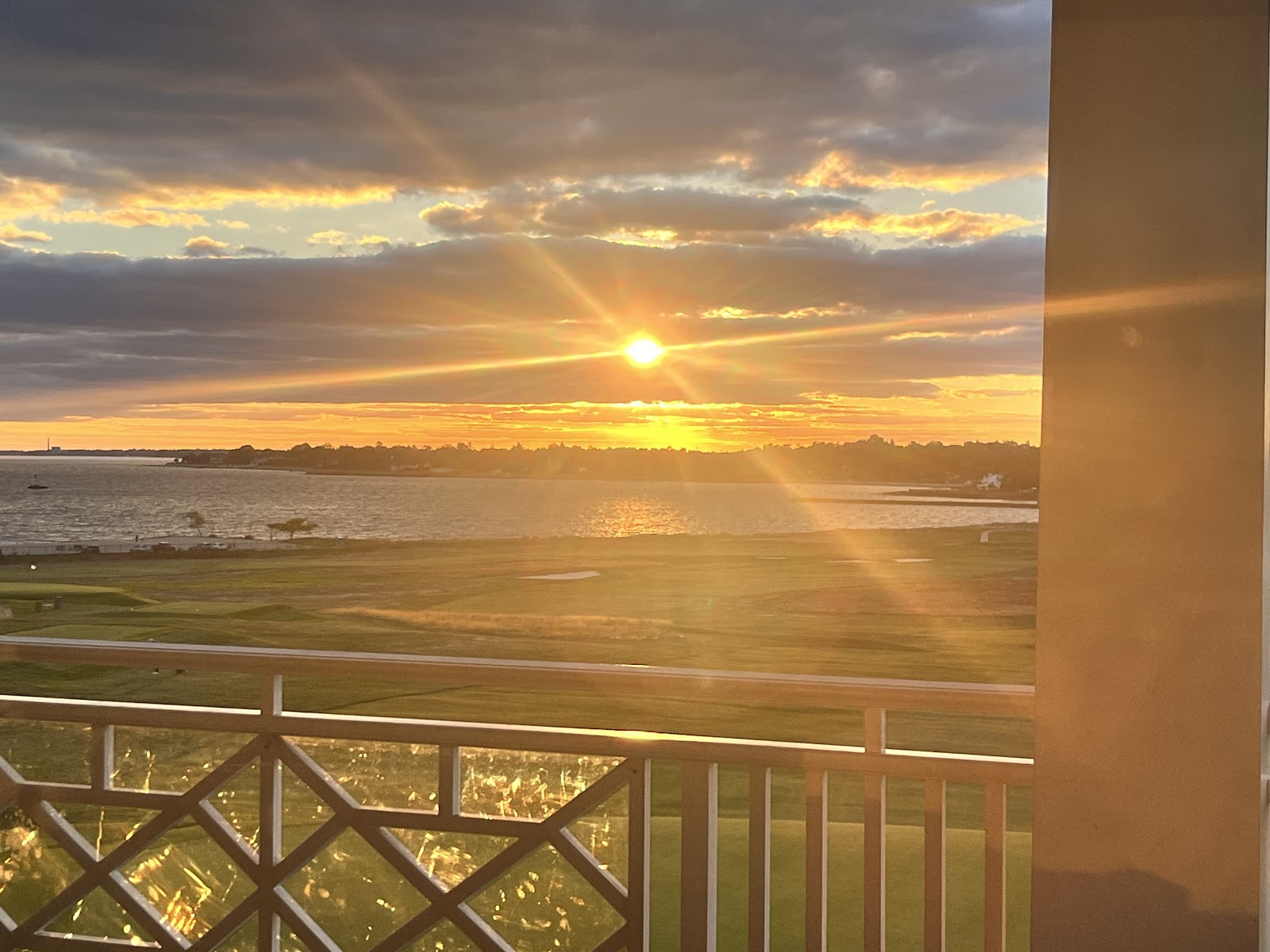
The Country Club of Fairfield
On the shore of Long Island Sound, Seth Raynor laid one of the great seaside puzzles of the American Northeast. Opened in 1921, The Country Club of Fairfield is a private par 70 of templates and tilted greens, where the wind, the marsh and the angles do the defending rather than length, a Golden Age original that still examines the best players who ever cross its threshold.
Photograph: The Country Club of Fairfield, via Google
The verdict
The Country Club of Fairfield is one of the purest Seth Raynor courses in America, a Golden Age seaside layout that has survived nearly untouched on its corner of Long Island Sound. Raynor was the engineer and construction genius behind Charles Blair Macdonald, and at Fairfield he built the template holes the two men carried over from the great links of Britain: the Redan, the Biarritz, the Short, the Eden, the Punchbowl. Stretched along salt marsh and shoreline, the course reads as a compact masterclass in strategy, where every green is boldly shaped and every approach asks a question of nerve and angle before length.
For the travelling golfer, Fairfield matters as a study in how little a great course needs to be great. At around 6,400 yards it is short by modern measure, yet the wind off the Sound, the firm seaside turf and Raynor's severe greens make par a genuine prize. It is intimate, walkable and quietly grand, the kind of club that golf architecture devotees cross the country to see. Access is the catch: this is a private members club, so a round comes through a member rather than a tee sheet. Folded into a tour of the Connecticut and New York coast, though, it ranks among the most rewarding classic courses a serious golfer can hope to play.
The Country Club of Fairfield at a glance
- Opened
- 1921
- Designer
- Seth Raynor
- Type
- Seaside classic
- Par
- 70
- Yardage
- Around 6,400 yds
- Access
- Private members club
Designer, opening year, par and yardage verified June 2026 from course databases and club sources. The Country Club of Fairfield plays as a par 70 of around 6,400 yards from the back tees. It is a private members club with no public green fee; access is as the guest of a member, and any cost is arranged privately. Policies change, so always confirm directly before planning a visit.
The holes worth the trip
Fairfield is best understood as a gallery of Raynor templates, and the par 3s are the headline. The Biarritz is the showpiece: a long one shotter to a vast green split by a deep swale, where finding the correct tier is the whole job and a back pin can leave a putt of fifty feet across the trough. The Redan asks the classic question, a green angled away and falling left so the bold player works the ball in off the right and lets the slope feed it home. The Short looks innocent at little more than a wedge, but its plateau green is ringed by fall offs that turn a careless miss into a bogey in a heartbeat.
Between them, the routing makes constant use of the shoreline and the marsh. Raynor squared his bunkers and built up his greens into clean, geometric forms that sit boldly on the seaside ground, and the wind off the Sound changes the course from one day to the next. A hole that plays a flick downwind in the morning can demand a full long iron into the teeth of the breeze by afternoon, so club selection is never settled and the same yardage rarely plays the same way twice. The Punchbowl and Eden holes reward the player who studies the contours and uses them, a reminder that this is golf of the ground as much as the air.
At a shade over 6,400 yards The Country Club of Fairfield will never bully a strong player with length, and that is precisely the point. The defense is wind, angle, firmness and green complex, the timeless toolkit of links golf transplanted to Connecticut. Walk it, read the greens, respect the breeze, and it reveals itself as one of the finest surviving examples of the Macdonald and Raynor school anywhere in the country.
How to get on
| What to know | Detail |
|---|---|
| Access | A private members club; there is no public green fee or visitor tee sheet, and play is as the accompanied guest of a member |
| Green fee | None published for visitors; any guest cost is arranged privately between member and host, so we quote no figure |
| Booking | Arranged by your member host; the course is walkable and caddies are the traditional way to play a Raynor design like this |
| On the day | A smart, traditional golf dress code applies on course and in the clubhouse; ground game and a soft touch on the greens pay off |
| Best months | May to October, when the seaside turf firms up and the wind off Long Island Sound is at its most interesting |
| Getting there | In Fairfield on the Connecticut coast, about an hour from New York City and easy to pair with other classic courses nearby |
Access rules verified June 2026 from club and course sources; private club policies change without notice, so always confirm directly before planning a visit. We can shape a wider Northeast golf trip around courses you can book. Ask about bookable Connecticut tee times.
Where to stay nearby
The Country Club of Fairfield sits on the Connecticut coast, so the natural bases are the harbor towns of Fairfield County, the city of New Haven a short drive east, or New York City itself about an hour to the southwest. A coastal base puts you close to the Sound and its classic courses, while the city offers the easiest air access and the widest choice of evenings.
Most visiting golfers fold Fairfield into a broader Northeast trip, given its private access. Pair a Connecticut stay with the other great courses of the region: the brawny Charles Banks and Raynor parkland of Yale Golf Course in New Haven, the Pete Dye championship test at TPC River Highlands in Cromwell, and the storied Newport Country Club just over the line in Rhode Island make a Northeast week you can build with confidence.
Looking for a base? See our recommended hotels and resorts near Fairfield and the Connecticut coast.
Build a Northeast golf trip
The Country Club of Fairfield is private, but the golf around it is not. We build trips through Connecticut, New York and Rhode Island, secure the bookable tee times, and handle hotels, caddies and the order of play. Tell us roughly when and who is travelling and one concierge costs it to the head, with no obligation.
The Country Club of Fairfield questions
Can the public play The Country Club of Fairfield?
No. The Country Club of Fairfield is a private members club and does not sell public green fees or visitor tee times. The usual route to a round is to play as the guest of a member, accompanied by your host. The club publishes no visitor rate, so access and any associated cost are arranged privately. Always confirm the current member guest policy directly with the club before planning a visit.
Who designed The Country Club of Fairfield?
The Country Club of Fairfield was designed by Seth Raynor and opened in 1921. Raynor was the great construction partner of Charles Blair Macdonald, and he laid out a seaside course along Long Island Sound built around his trademark template holes, including the Redan, the Biarritz and the Short, with the bold, geometric greens that are his signature.
What is the par and yardage at The Country Club of Fairfield?
The Country Club of Fairfield plays as a par 70 of around 6,400 yards from the back tees. It defends par with wind, angles, salt marsh and Raynor's severely contoured greens rather than length, which is why it still examines strong players despite its modest measure.
Where is The Country Club of Fairfield?
The Country Club of Fairfield is in Fairfield, Connecticut, on the shore of Long Island Sound about an hour from New York City. Its seaside setting and Raynor templates make it one of the standout classic courses of the Connecticut coast, within easy reach of New Haven and Rhode Island for a wider trip.
Related
The Tee Sheet
Tee time windows, course access changes and the trips worth taking. Every other week.
Researched and written by the GolfForKings editorial desk. Designer, opening year, par, yardage and access verified June 2026. Last reviewed June 2026.