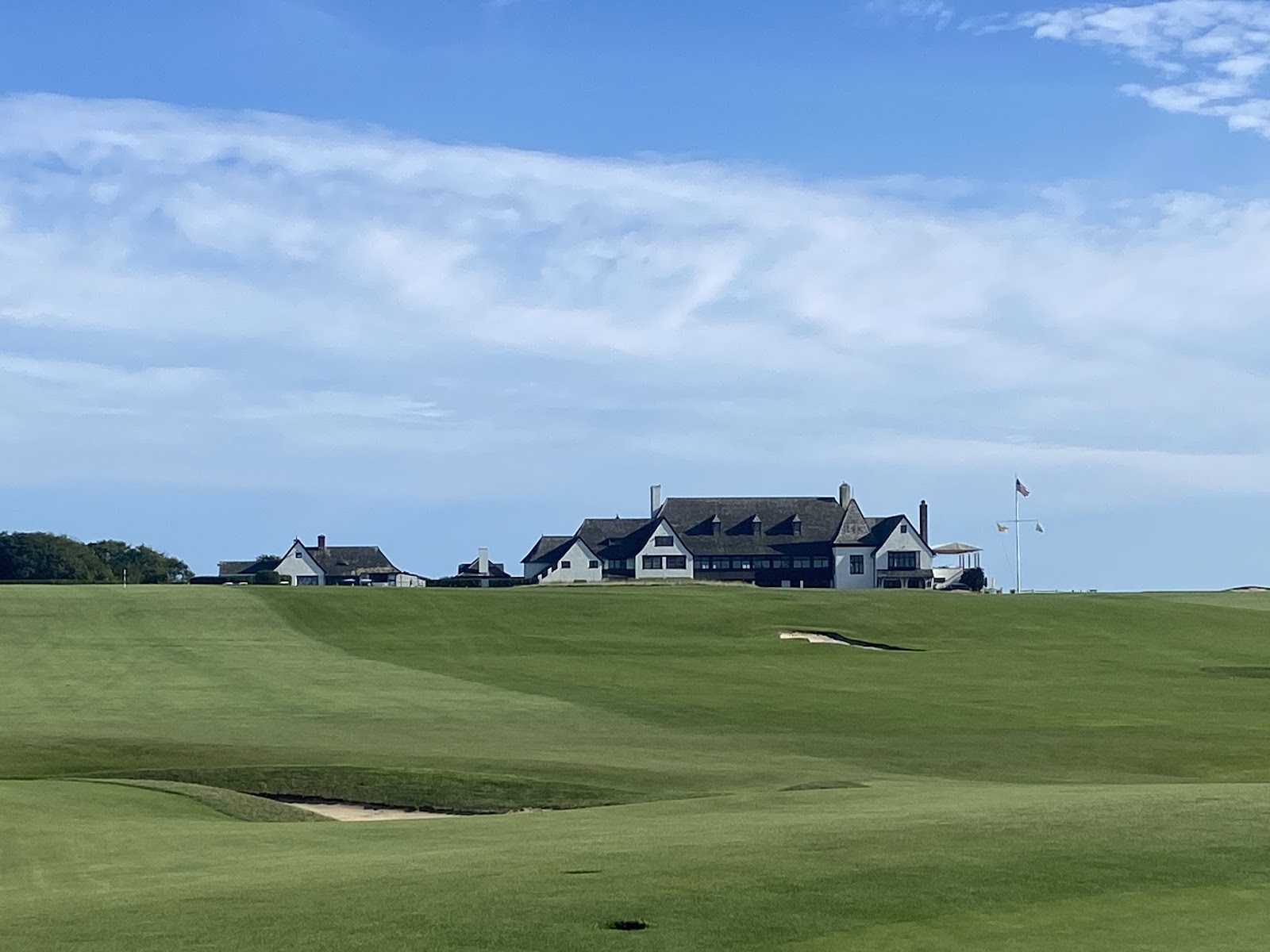
Maidstone Club
The closest thing to a Scottish links on the American Atlantic. Maidstone runs through tall dunes on the ocean edge of East Hampton, a par 72 of about 6,560 yards shaped in large part by Willie Park Jr., short by modern numbers and entirely a question of wind, sand and nerve.
Photo: Maidstone Club via Google.
The verdict
Maidstone is the rare American course that feels genuinely transplanted from the British Isles. Golf here dates to 1891, when the club laid out a handful of holes among the dunes, but the course that golfers travel to see owes most to Willie Park Jr., the two time Open champion turned architect, who reworked it and pushed it out onto the Gardiner Peninsula dunes in 1924. The land does the heavy lifting: high, grassy ridges, blind shots over crests, greens tucked in hollows, and the Atlantic close enough that the salt air and the breeze are constant companions.
It plays as a par 72 of about 6,560 yards, which sounds modest until the wind gets up and the short par 4s and exposed par 3s start to bare their teeth. There is no length to hide behind and no trees to stop a wayward ball; the defense is the dunes, the fescue and the firm, fast turf. The membership keeps Maidstone resolutely private and low key, so for a traveling golfer it is a member's invitation or nothing, but it completes the extraordinary run of links on eastern Long Island alongside Shinnecock Hills and the National Golf Links of America, and few courses anywhere are more purely fun to play.
Maidstone at a glance
- Founded
- 1891
- Designer
- Willie Park Jr.
- Type
- Links
- Par
- 72
- Yardage
- About 6,560 yds
- Green fee
- Members and guests
Founding year, design history, par and length verified June 2026 from the club and leading course databases. The 18-hole links is the work of Willie Park Jr., who reshaped and extended it in 1924, and plays as a par 72 of about 6,560 yards at East Hampton, New York. It is a private club; access is generally only through a member, so always confirm directly before booking.
The holes worth the trip
Maidstone is at its best when it climbs into the big dunes near the ocean. The stretch around the 8th, 9th and 10th, where the course reaches the high ground and the sea comes into view, is among the most thrilling in American golf, a run of holes that tumble over and through the sand hills with blind carries and greens hidden behind crests. The short par 4s here ask the player to choose a line and commit, with bunkers and broken ground waiting for the timid and the greedy alike.
The par 3s are Maidstone's calling card. Played across or along the dunes, exposed to whatever the Atlantic sends, they swing from a flick of a wedge to a desperate long iron depending on the day, and the green complexes punish anything but the truest strike. There is no water in play of any consequence and no need for it; the wind and the fescue are defense enough, and the fast, tilted greens demand a deft touch that length never buys.
What stays with visitors is how much the course depends on the elements and how little it depends on yardage. On a still morning Maidstone can be gentle and charming; on a blustery afternoon it becomes a stern, old fashioned examination of ball control and imagination. It is golf as the game's founders would recognize it, set down on one of the loveliest pieces of coast in the country.
How to get on
| What to know | Detail |
|---|---|
| Access | Private members club; not open to public play, with access usually only through a member |
| Green fee | No published public fee; any guest play is hosted by a member (indicative, 2026) |
| Booking | An introduction through a member, arranged well in advance, is essential |
| On the day | Caddies available and walking is the tradition; a collared shirt and a traditional dress code expected |
| Getting there | East Hampton, on the South Fork of Long Island, about two and a half hours east of Manhattan by car |
| Best months | Late spring through early autumn, when the links is firm and the ocean breeze is the main defense |
Access arrangements verified June 2026; Maidstone is a private club and policies change, so always confirm directly before planning a visit with the club or your trip planner.
Where to stay nearby
East Hampton and the wider Hamptons supply the lodging, from village inns and boutique hotels a short drive from the club to the larger resorts along the South Fork toward Montauk. It is a summer playground, so book early and expect peak season rates between June and September.
Maidstone completes the run of great links on eastern Long Island, alongside Shinnecock Hills, the National Golf Links of America and Sebonack, so it anchors a memorable Hamptons golf trip. We can help with the introductions where possible and build the lodging and transfers around your rounds.
Looking for a base? See our recommended hotels and resorts around the Hamptons.
Build a New York golf trip
We help arrange access where we can, plan the visit to Maidstone and book the lodging and transfers around your round. Tell us roughly when and who is travelling and one concierge costs it to the head, with no obligation.
Maidstone questions
Who designed the Maidstone Club golf course?
Golf at Maidstone dates to 1891, but the 18-hole course played today owes most to Willie Park Jr., who reworked and extended it onto the Gardiner Peninsula dunes in 1924.
What is the par and length of Maidstone?
The 18-hole links at Maidstone plays as a par 72 of about 6,560 yards, a short but exacting test among the Atlantic dunes at East Hampton.
Can visitors play Maidstone?
Maidstone is a private members club and is not open to public play. Access is generally only through a member, so a visit must be arranged well in advance.
How many holes does Maidstone have?
Maidstone today has 27 holes, an 18-hole championship links and a separate nine, after the great course was reduced from two full eighteens by the Hurricane of 1938.
Related
The Tee Sheet
Tee time windows, course access changes and the trips worth taking. Every other week.
Researched and written by the GolfForKings editorial desk. Founding year, design history, par and yardage verified June 2026. Last reviewed June 2026.