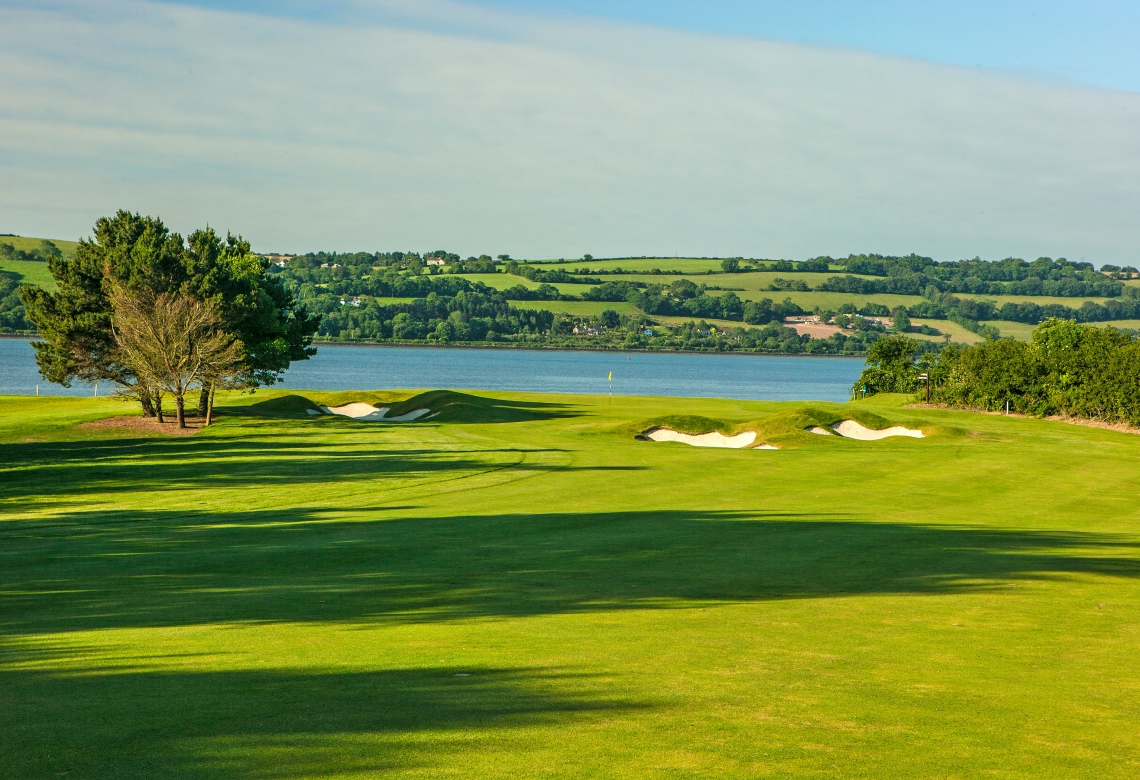
Cork Golf Club
On a peninsula in Cork Harbour sits one of Alister MacKenzie's quiet masterpieces, a parkland course routed through the walls and water of disused limestone quarries. The architect of Augusta National and Cypress Point left his fingerprints all over Little Island, and the result is a clever, characterful round unlike any other in the southwest.
Photo: Cork Golf Club via Google.
The verdict
Cork Golf Club, known to everyone as Little Island, is the kind of course that rewards a closer look. Founded in 1888, it was redesigned in 1927 by Alister MacKenzie, the genius behind Augusta National and Cypress Point, and his hand shows in the bold green contours and the inventive use of the land. The middle holes drop into old limestone quarries on the shore of Cork Harbour, where sheer rock walls and tidal water frame some of the most distinctive golf in Ireland.
This is not a links and it is not trying to be one. It is a mature, tree lined parkland with MacKenzie's strategic intelligence woven through it, the large tiered greens asking constant questions of approach and putt. For the travelling golfer touring the famous links of the southwest, Cork is the perfect counterpoint, a city course steeped in architecture and history just minutes from the airport, easy to reach and hard to forget.
Cork Golf Club at a glance
- Founded
- 1888
- MacKenzie redesign
- 1927
- Type
- Parkland
- Par
- 72
- Yardage
- 6,730 yds
- Green fee
- From €90 to €110
Founding date, the 1927 Alister MacKenzie redesign, par and yardage verified June 2026 from the club and course databases. The course plays to a par of 72 at around 6,730 yards from the championship tees. Green fees are indicative, roughly 90 to 110 euros for a round in the 2025 to 2026 seasons, with off peak and group rates. Fees change by season and year, so always confirm directly before booking.
The holes worth the trip
Cork eases you in through mature parkland before the drama arrives at the harbour. The middle stretch plunges into the old quarry, where MacKenzie used the rock faces and the tidal water of Cork Harbour as natural hazards, and holes such as the par 4s along the shore deliver scenery and strategy you simply do not find on an inland course.
The greens are pure MacKenzie, large, tiered and full of movement, so that finding the putting surface is only half the task. Approach to the wrong level and a three putt looms; read the borrows wrong and par slips away. This is golf that rewards the thinking player, the one who studies the contours and plays to the percentages rather than firing at every flag.
The closing holes climb back from the water through the trees, a gentler finish that gives time to reflect on a round of real variety. Cork never overpowers you, but its blend of harbourside quarry holes and clever parkland greens leaves a lasting impression. It is a course that grows on every golfer who takes the trouble to understand it.
How to get on
| What to know | Detail |
|---|---|
| Access | A members club that welcomes visitors and societies with a booked tee time throughout the season |
| Green fee | Around 90 to 110 euros for a round, with off peak, twilight and group rates available (indicative) |
| Booking | Reserve through the club ahead of a southwest trip; weekend mornings are busiest |
| On the day | A walking parkland with buggies available; a welcoming clubhouse with harbour views and good catering |
| Getting there | At Little Island just east of Cork city, about ten minutes from Cork Airport and the N25 |
| Best months | May to September for the driest conditions, though the parkland turf plays well much of the year |
Access and indicative green fees verified June 2026 from the club; they change without notice, so always confirm directly before booking with Cork Golf Club or your trip planner. Check tee time availability.
Where to stay nearby
Cork city is the obvious base, ten minutes away, with everything from riverside hotels to boutique stays and easy access to the airport for the start or end of a tour. The harbour town of Cobh and the foodie village of Kinsale are both close at hand for those who want a scenic base with a strong dining scene.
Little Island is the ideal first or last round of a southwest Ireland trip. Pair it with the cliffs of Old Head of Kinsale just down the coast, then head west to the great links of Tralee, Ballybunion and Lahinch. Folding a clever MacKenzie parkland into a links heavy itinerary gives the week a welcome change of texture.
Looking for a base? See our recommended hotels and resorts near Cork.
Open a southwest Ireland tour at Cork
We pair Cork and the Old Head of Kinsale with the great links of Kerry and Clare, book the tee times in the right order and handle the hotels and the driving. Tell us roughly when and who is travelling and one concierge costs it to the head, with no obligation.
Cork Golf Club questions
Who designed Cork Golf Club?
Cork Golf Club at Little Island was founded in 1888 and redesigned in 1927 by Alister MacKenzie, the architect of Augusta National and Cypress Point. His bold green contours and strategic routing through the limestone quarries define the course.
What are the par and length of Cork Golf Club?
Cork is a par 72 parkland of around 6,730 yards from the championship tees. The challenge lies in MacKenzie's large tiered greens and the quarry holes on Cork Harbour rather than sheer length.
Is Cork Golf Club a links course?
No. Cork is a mature parkland course, though its most famous stretch drops into disused limestone quarries on the shore of Cork Harbour, giving it a coastal character unusual for an inland course.
How much does it cost to play Cork Golf Club?
Indicative green fees run around 90 to 110 euros for a round in the 2025 to 2026 seasons, with off peak and group rates. Fees change by season and year, so always confirm directly before booking.
Related
The Tee Sheet
Tee time windows, course access changes and the trips worth taking. Every other week.
Researched and written by the GolfForKings editorial desk. Design history, par and yardage verified June 2026; indicative green fees verified June 2026. Last reviewed June 2026.